“How much RSO should I take?” is the question behind almost every other RSO question. There is no single right number, because the same dose lands differently depending on your body, your tolerance and what you ate. What we can give you is the starting point printed on each of our products, the math to turn any form into milligrams, and the research on why oral doses behave the way they do. For step-by-step use of each form, see the guides linked at the end.
This chart is educational, not medical advice. If you take other medications or are managing a health condition, set your starting point with a clinician who knows your history.
How much RSO should I take?
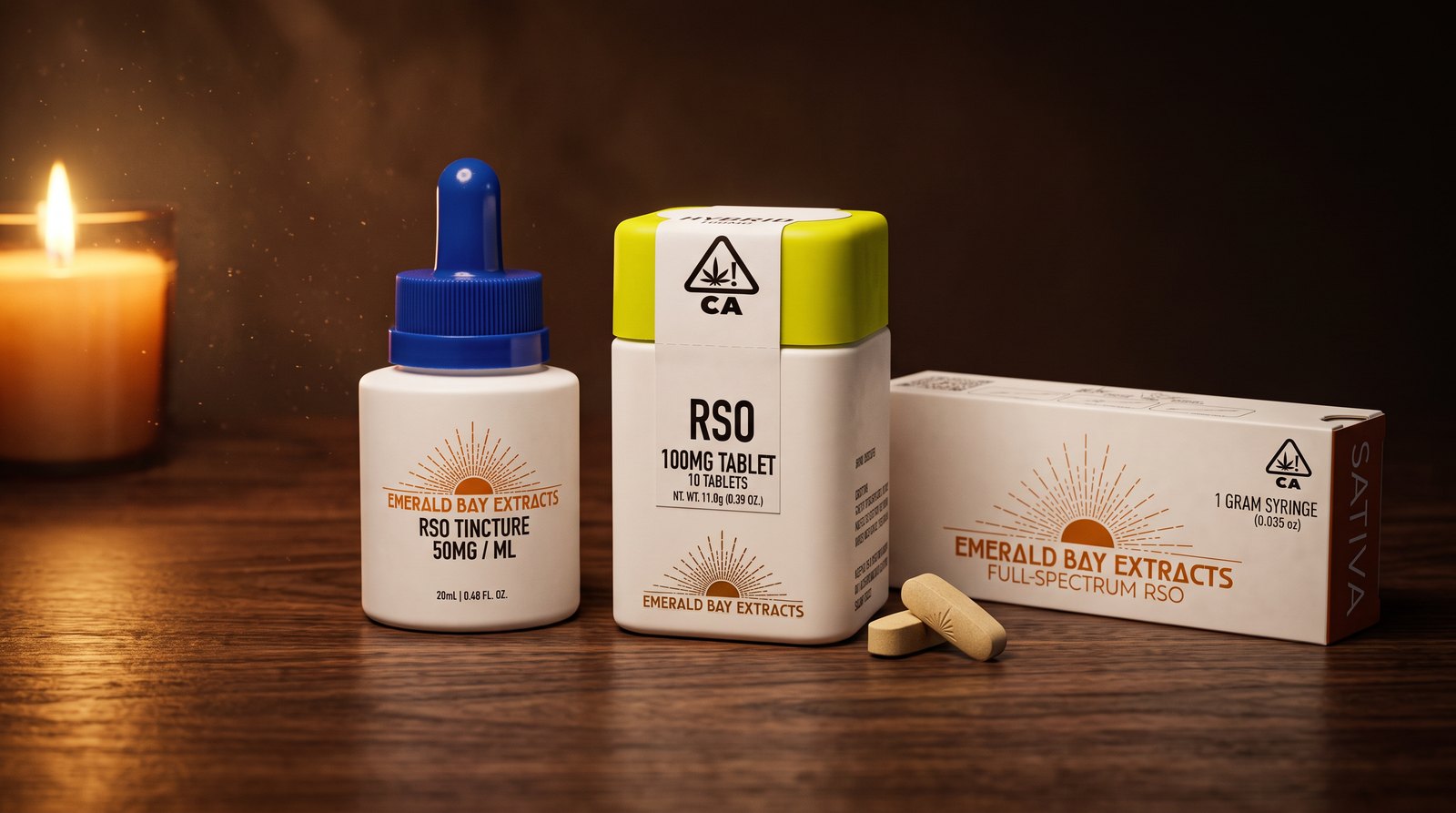
Start with the smallest practical dose of the form you have, and treat the first few doses as information gathering. The chart below lists the first dose suggested on each Emerald Bay product page.
| Form and strength | Suggested first dose | About how much THC | Who it’s for |
|---|---|---|---|
| 10 mg tablet | One tablet | 10 mg | A sensible first dose if you’re new to RSO |
| 25 mg tablet (scored) | One quarter | About 6 mg | New to RSO tablets; halves (12.5 mg) once you know your response |
| 50 mg tablet (scored) | Not a first dose: start with a 10 or 25 mg tablet | — | People who already know their level |
| 100 mg tablet | Not a beginner product, even split | — | Experienced patients with an established tolerance |
| 20 mg tablet (New Mexico) | Half a tablet | 10 mg | Scored into two 10 mg halves; take one half and wait |
| 1 g RSO syringe | A rice-grain-sized amount or smaller; the label suggests about half a grain | Roughly 13–18 mg in a half-grain drop of THC-dominant oil | A sliver smaller than half a grain is a reasonable start if you’re new |
| 50 mg/ml tincture | A small measured dose: 1–2 drops | About 2.5–5 mg | Anyone who wants to adjust in small steps |
For context, researchers have proposed treating 5 mg of THC as one “standard unit” across all cannabis products, and a 2021 clinician consensus on medical cannabis suggested people new to THC begin around 1 to 2.5 mg and increase slowly over days. More is not always better: in a controlled study, 7.5 mg of oral THC reduced distress during a stressful task, while 12.5 mg increased negative mood.
How do I turn an RSO dose into milligrams?
Tablets are the simplest: the strength is printed on the package, and scored tablets split cleanly into halves or quarters. Tinctures take a little math. At 50 mg per ml:
| Amount | Approximate volume | Approximate THC |
|---|---|---|
| 1 drop | About 0.05 ml (drop size varies) | About 2.5 mg |
| 2 drops | About 0.1 ml | About 5 mg |
| Quarter dropper | 0.25 ml | 12.5 mg |
| Half dropper | 0.5 ml | 25 mg |
| Full dropper | 1 ml | 50 mg |
Syringes are the hardest to measure by eye. A 1 g syringe holds the total milligrams printed on its label, and our RSO syringe guide explains how the half-grain-of-rice drop works out to roughly 13 to 18 mg in THC-dominant oil, or about 50 doses per syringe. If you want precise small steps, a tablet or tincture is easier than oil.
How much RSO should I take if I smoke every day?
Daily smokers usually need more than a first-timer, but less than they expect. Two things are happening at once.
Tolerance is real, and partial. A systematic review of human studies found that regular users feel acute effects less strongly than occasional users. Tolerance was strongest for effects on thinking and memory and only partial for feeling high and for heart rate. Brain imaging shows why: daily smokers have fewer CB1 receptors in parts of the brain, and the number returned to normal after about four weeks without cannabis.
Swallowing is a different route. Smoked THC goes from the lungs to the brain in minutes. Swallowed THC passes through the liver first, which converts part of it into 11-hydroxy-THC, an active metabolite; a pharmacology review describes this as one reason oral cannabis feels different from smoked cannabis at a similar dose. Tolerance built by smoking doesn’t translate milligram for milligram.
A common approach for daily smokers who are new to RSO is to begin around 10 mg (a 10 mg tablet, or half of a 25 mg tablet), wait the full two hours, and step up by about 5 to 10 mg on a later day if it wasn’t enough. Jumping straight to a 50 or 100 mg tablet because you smoke a lot is the most common way to have a long, uncomfortable afternoon.
| Experience | Common starting point | Step up by |
|---|---|---|
| New to cannabis | 2.5–5 mg (one or two tincture drops, or a sliver of oil) | 2.5 mg, on a later day |
| Occasional edible user | About 5–10 mg (a quarter of a 25 mg tablet, or a 10 mg tablet) | About 5 mg |
| Daily smoker, new to oral RSO | About 10 mg | 5–10 mg, on a later day |
| Established oral RSO user | The dose you already know works | Change one thing at a time |
How long should I wait before taking more RSO?
At least two hours. In a controlled study of oral cannabis at 10, 25 and 50 mg of THC, effects peaked 1.5 to 3 hours after the dose and lasted 6 to 8 hours. Redosing at the one-hour mark, when “nothing is happening,” is how two doses end up arriving together. That pattern shows up in emergency data: in a Colorado hospital study, edibles accounted for more cannabis-related visits than their share of sales would predict. We explain the timing in how long RSO takes to kick in.
How do you make RSO hit harder?
If you mean getting more from the same dose, there are a few things the research supports, and one it doesn’t.
- Take it with food that has some fat. In a controlled trial, a high-fat meal increased total THC exposure and delayed the peak compared with an empty stomach. A similar 2025 study of a CBD-rich extract found the same pattern for CBD. Expect a slower start and a longer curve.
- Keep conditions consistent. Same time of day, same food situation. That makes each dose easier to judge, so you can adjust with information instead of memory.
- Lower your tolerance. If the same dose has stopped working, a break may help more than a bigger dose; the imaging study above saw CB1 receptors recover after about four weeks. See our guide to tolerance breaks.
- Don’t stack doses. Taking more before the first dose peaks doesn’t make RSO stronger; it makes the peak harder to predict.
How do I take each form of RSO?
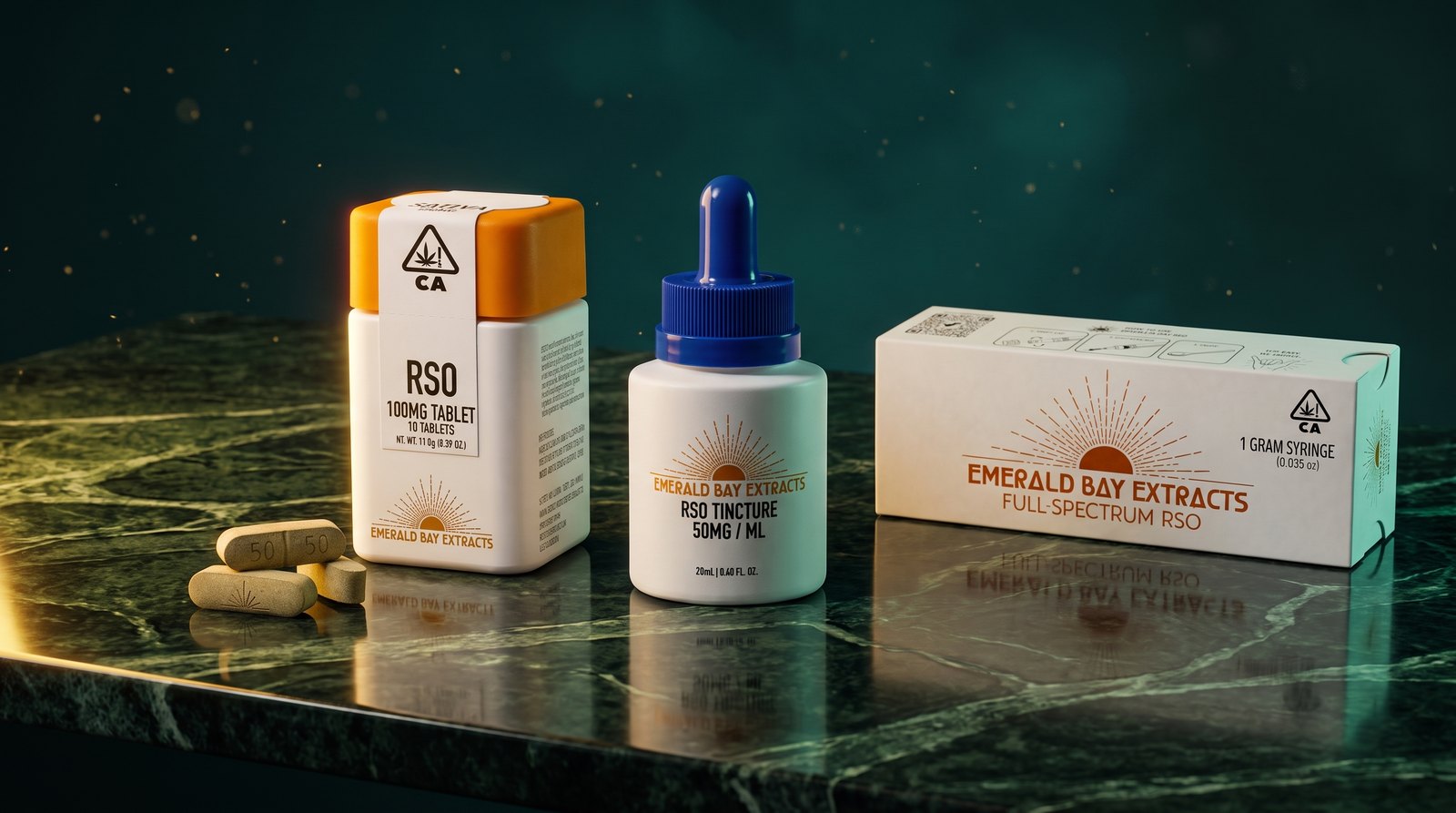
Scored tablets remove most of the guesswork, tinctures are the most adjustable, and syringes are the most concentrated and the hardest to measure. Each has its own step-by-step guide:
- Tablets: RSO tablets how-to guide (splitting, timing, storage) and RSO tablets, pills and capsules compared.
- Syringes: RSO syringe guide (opening, warming, measuring a drop).
- Tinctures: THC tincture dosage guide (reading the dropper, holding drops under the tongue).
- Daytime use: 7 tips for daytime dosing.
Browse RSO tablets, syringes and tinctures. Emerald Bay products are sold only at licensed dispensaries in California and New Mexico, never online. Find a store on our store locator.
Frequently asked questions
How much RSO is a grain of rice?
It depends on the oil’s potency. Our syringe label suggests a first dose about half a grain of rice, which works out to roughly 13 to 18 mg of THC in THC-dominant oil. If you’re new, a sliver smaller than that is a reasonable start.
Is 100 mg of RSO a lot?
Yes, for most people. A 100 mg tablet is meant for experienced patients with an established tolerance, and it isn’t a starting point even when split. Begin with a 10 mg or 25 mg tablet.
How much RSO should a beginner take?
Roughly 2.5 to 10 mg of THC: a quarter of a 25 mg tablet, one 10 mg tablet, one or two drops of a 50 mg/ml tincture, or a sliver of syringe oil. Wait at least two hours before taking more.
Should I take RSO with food?
Many people do. A high-fat meal increased how much THC was absorbed in a controlled trial, and it also delayed the peak, so effects may start later and last longer.
Can I take RSO every day?
Many people do, often at the same time each day. Daily use builds tolerance, and THC can interact with other medications, so check with a pharmacist if you take any.
This article is educational and doesn’t provide medical or dosing advice. Individual responses to cannabis vary widely. Cannabis is for adults 21+ (18+ with a qualifying medical recommendation in California), laws differ by location, and cannabinoids can interact with other medications. Don’t drive after a dose. If you’re pregnant, nursing, or managing a medical condition, talk with a healthcare provider who knows your full history.
Sources
- Freeman TP, Lorenzetti V. "'Standard THC units': a proposal to standardize dose across all cannabis products and methods of administration." Addiction. 2020. PubMed
- Bhaskar A, et al. "Consensus recommendations on dosing and administration of medical cannabis to treat chronic pain: results of a modified Delphi process." J Cannabis Res. 2021. PMC8252988 · PubMed
- Childs E, Lutz JA, de Wit H. "Dose-related effects of delta-9-THC on emotional responses to acute psychosocial stress." Drug Alcohol Depend. 2017. PMC6349031 · PubMed
- Colizzi M, Bhattacharyya S. "Cannabis use and the development of tolerance: a systematic review of human evidence." Neurosci Biobehav Rev. 2018. PubMed
- Hirvonen J, et al. "Reversible and regionally selective downregulation of brain cannabinoid CB1 receptors in chronic daily cannabis smokers." Mol Psychiatry. 2012. PMC3223558 · PubMed
- Lucas CJ, Galettis P, Schneider J. "The pharmacokinetics and the pharmacodynamics of cannabinoids." Br J Clin Pharmacol. 2018. PMC6177698 · PubMed
- Vandrey R, et al. "Pharmacokinetic Profile of Oral Cannabis in Humans: Blood and Oral Fluid Disposition and Relation to Pharmacodynamic Outcomes." J Anal Toxicol. 2017. PMC5890870 · PubMed
- Monte AA, et al. "Acute Illness Associated With Cannabis Use, by Route of Exposure: An Observational Study." Ann Intern Med. 2019. PMC6788289 · PubMed
- Lunn S, et al. "Human Pharmacokinetic Parameters of Orally Administered Δ9-Tetrahydrocannabinol Capsules Are Altered by Fed Versus Fasted Conditions and Sex Differences." Cannabis Cannabinoid Res. 2019. PMC6922062 · PubMed
- Saals BADF, et al. "A high-fat meal significantly impacts the bioavailability and biphasic absorption of cannabidiol (CBD) from a CBD-rich extract in men and women." Sci Rep. 2025. PMC11779803 · PubMed
- Brown JD, Winterstein AG. "Potential Adverse Drug Events and Drug-Drug Interactions with Medical and Consumer Cannabidiol (CBD) Use." J Clin Med. 2019. PMC6678684 · PubMed